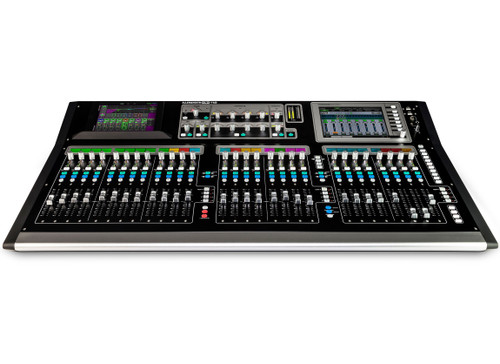
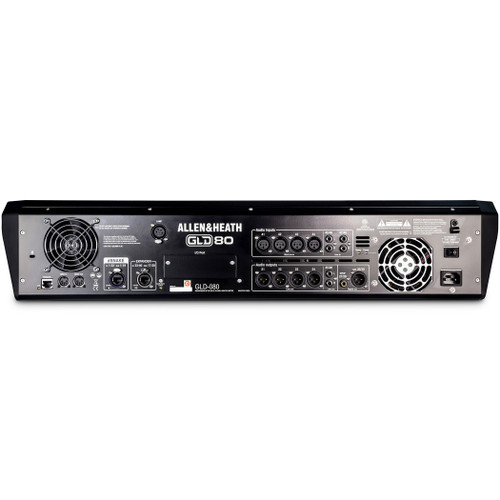
| XLR Mic/Line Inputs |
Balanced, (All XLR on GLD‐80 and AudioRacks) |
| Mic/Line Preamp |
Fully recallable |
| Input Sensitivity |
‐60 to +15dBu |
| Analogue Gain |
+5 to +60dB, 1dB steps |
| Pad |
‐20dB |
| Maximum Input Level |
+32dBu |
| Input Impedance |
>4kÙ (Pad out), >10kÙ (Pad in) |
| Mic/Line Channel noise |
20‐20kHz, Direct Out @ unbalanced out |
| Mic EIN |
‐127dB with 150Ω source |
| Unity gain (Pad in) |
‐90dBu |
| Low gain (5dB, Pad out) |
‐93dBu |
| Mid gain (30dB, Pad out) |
‐89dBu |
| Mic/Line Channel THD+N |
20‐20kHz, Direct Out @ unbalanced out |
| Unity gain (Pad in) |
0.005% ‐86dBu @ 1kHz, 0dBu output |
| Low gain (5dB, Pad out) |
0.003% ‐89dBu @ 1kHz, 0dBu output |
| Mid gain (30dB, Pad out) |
0.004% ‐88dBu @ 1kHz, 0dBu output |
| RCA Line Inputs |
Unbalanced (GLD‐80) |
| Input Sensitivity |
‐24 to +24dBu, nominal 0dBu |
| Trim |
+/‐24dB, recallable |
| Maximum Input Level |
+18dBu |
| Input Impedance |
>10kΩ |
| RCA channel Noise |
‐92dBu 20‐20kHz |
| RCA channel THD+N |
0.0035% ‐90dBu @ 1kHz, 0dBu output |
| XLR Outputs |
Balanced, Relay protected |
| Output Impedance |
|
| Nominal Output |
+4dBu = 0dB meter reading |
| Maximum Output Level |
+22dBu |
| Residual Output Noise |
‐91dBu (muted, 20‐20kHz) |
| RCA Line Outputs |
Balanced, Relay protected |
| Output Impedance |
|
| Nominal Output |
0dBu = 0dB meter reading |
| Maximum Output Level |
+18dBu |
| Residual Output Noise |
‐94dBu (muted, 20‐20kHz) |
| Digital Outputs |
48kHz sampling rate |
| SPDIF |
RCA, 600mV, coax terminated input 75Ω |
| AES3 2 ch XLR output |
XLR, 2.5Vpp balanced terminated 110 Ω |
| Output |
Measured balanced XLR in to XLR out, 20]20kHz, minimum Gain, Pad out |
| Dynamic Range |
112dB |
| System Signal to Noise |
‐90dB |
| Frequency Response |
0/‐0.25dB @ 20Hz, 0/‐0.5dB @ 20kHz |
| System peak level THD+N |
0.0055% ‐68dBu @ +17dBu output, 1kHz |
| System Line level THD+ N |
0.0022%, ‐84dBu @ +9dBu output, 1kHz |
| Headroom |
+18dB |
| Internal operating Level |
0dBu |
| dBFS Alignment |
+18dBu = 0dBFS (+22dBu at XLR output) |
| Meter Calibration |
0dB meter = ‐18dBFS (+4dBu at XLR out) |
| Meter Peak indication |
‐3dBFS (+19dBu at XLR out) |
| Meter Type |
Fast (peak) response |
| Sampling Rate |
48kHz +/‐100PPM |
| ADC |
24‐bit Delta‐Sigma |
| DAC |
24‐bit Delta‐Sigma |
| Latency |
1.49ms (GLD‐80 local XLR in to XLR out)0.68ms (GLD‐80 local XLR in to digital out) |
| USB Playback |
2 channel, WAV, FLAC 44.1/48kHz |
| USB Record |
2 channel, 48kHz / 16bit ‐ WAV |
| I/O Port |
64 channel bi‐directional |
| Card Options |
A&H ACE, MADI, Dante, ES, Waves, MMO |
| Operating Temperature |
0 deg C to 35 deg C (32 deg F to 95 deg F) |
| GLD‐112 |
100‐240V AC, 50/60Hz, 110W max |
| Touch Screen |
8.4" TFT, 800x600 resolution |
| Faders |
100mm motorised |
| GLD‐112 |
Fader Strips 3 Banks (12,8,8), 4 Layers = 112x strips |
| Strip Display |
LCD per strip, assignable backlight colours |
| SoftKeys |
10 assignable |
| MIDI |
MIDI In and Out |
| Network |
TCP/IP Ethernet |
| 48 Processing Channels |
Mono = 1‐44, Stereo = 45/46, 47/48 |
| Trim |
+/‐24dB digital trim |
| Polarity |
Normal/Reverse |
| High Pass Filter |
12dB/octave 20Hz – 2kHz |
| Insert |
Assign to any sockets, In/Out, +4dBu/‐10dBV level |
| Delay |
Up to 85ms, Bypass switchInput global setting ‐ ms, feet, meters, samples |
| Sidechain |
Self key, In/Out, Sel 'listen' |
| Sidechain Lo]Cut Filter |
12dB/octave, Freq 20Hz . 5kHz |
| Sidechain Hi‐Cut Filter |
12dB/octave, Freq 120Hz – 20kHz |
| Threshold |
‐72dBu to +12dBu |
| Depth |
0 to 60 dB |
| Attack |
50us to 300ms |
| Hold |
10ms to 5s |
| Release |
10ms to 1s |
| Type |
4‐Band fully parametric, +/‐15dB |
| Frequency Range |
Global setting for Inputs = 20‐20kHz or 'Analogue' |
| Analogue Ranges |
20‐200Hz, 35‐1kHz, 500‐15kHz, 2k‐20kHz |
| Band 1 |
Selectable LF Shelving, Bell, Hi‐Pass |
| Band 2 |
Bell |
| Band 3 |
Bell |
| Band 4 |
Selectable HF Shelving, Bell, Lo‐Pass |
| Bell Width |
Non‐constant Q, variable, 1.5 to 1/9th octave |
| Shelving Type |
Classic Baxandall |
| Hi‐Pass, Lo‐Pass Filter |
12dB/octave |
| Sidechain |
Self key, In/Out, Sel 'listen' |
| Sidechain Lo‐Cut Filter |
12dB/octave, Freq 20Hz – 5kHz |
| Sidechain Hi‐Cut Filter |
12dB/octave, Freq 120Hz – 20kHz |
| Threshold |
‐46dBu to 18dBu |
| Ratio |
1:1 to infinity |
| Attack |
300us – 300ms |
| Release |
100ms – 2s |
| Knee |
Soft/Hard |
| Manual Types |
Peak Manual, RMS Manual |
| Auto Types |
VocalAuto, OptoAuto, PunchBag |
| Channel Direct Out |
Individual Trim (per channel) |
| Options |
Source, follow Fader, follow Mute (global for all) |
| 20 Mix Channels |
Configure as mono/stereo Groups, Aux, Main, MatrixMains = None, LR, LCR. LR+M(bus), LR+M(sum) |
| External Input |
Assignable source |
| Trim |
+/‐24dB digital trim |
| Polarity |
Normal/Reverse |
| Insert |
Assign to any sockets, In/Out, +4dBu/‐10dBV level |
| Delay |
Up to 170ms, Bypass switchMix global setting ‐ ms, feet, meters, samples |
| Type |
Constant 1/3 octave, 28 bands 31Hz ‐16kHz |
| Gain |
+/‐12dB |
| GEQ Fader Flip Mode |
2 overlapping frequency banks on strip fadersSEL key resets frequency band to 0dB |
| GEQ Fader Flip Mode |
RTA following PAFL is displayed on strip meters |
| Type |
4‐Band fully parametric, +/‐15dB |
| Frequency Range |
Global setting for Mixes = 20‐20kHz or 'Analogue' |
| Analogue Ranges |
20‐200Hz, 35‐1kHz, 500‐15kHz, 2k‐20kHz |
| Band 1 |
Selectable LF Shelving, Bell, Hi‐Pass |
| Band 2 |
Bell |
| Band 3 |
Bell |
| Band 4 |
Selectable HF Shelving, Bell, Lo‐Pass |
| Bell Width |
Non‐constant Q, variable, 1.5 to 1/9th octave |
| Shelving Type |
Classic Baxandall |
| Hi‐Pass, Lo‐Pass Filter |
12dB/octave |
| Sidechain |
Self key, In/Out, Sel 'listen' |
| Sidechain Lo‐Cut Filter |
12dB/octave, Freq 20Hz – 5kHz |
| Sidechain Hi‐Cut Filter |
12dB/octave, Freq 120Hz – 20kHz |
| Threshold |
‐46dBu to 18dBu |
| Ratio |
1:1 to infinity |
| Attack |
300us – 300ms |
| Release |
100ms – 2s |
| Knee |
Soft/Hard |
| Manual Types |
Peak Manual, RMS Manual |
| Auto Types |
VocalAuto, OptoAuto, PunchBagfilter in/out with sel ‘listen’ |
| Internal FX |
8x RackFX engine |
| Types |
Reverbs, Delays, Modulators, Sub‐harmonics,Pitch Shift, Rotary Speaker, De‐Esser |
| Mode |
Send>Return, Inserted, Daisy Chain FX |
| 8 Stereo dedicated returns |
Adds to inputs for up to 56 sources to the mix |
| Controls |
Fader, Pan, Mute, Routing to Grp, Aux, FX, Main |
| FX Return PEQ |
Same as Input Channel PEQ |
| Talkback |
Assignable source |
| Mode |
Latched/Momentary, PAFL Dim option |
| High Pass Filter |
12dB/octave, 20Hz‐2kHz |
| Routing |
To Groups, Aux, Main, Matrix |
| Level Trim |
+/‐24dB |
| Signal Generator |
Sine, White Noise, Pink Noise, Bandpass Noise |
| Sine, Bandpass sweep |
20‐20kHz |
| Controls |
Level, Mute |
| Routing |
To Groups, Aux, Main, Matrix |
| RTA |
31‐Bands 1/3 octave 20‐20kHz |
| Source |
Follows selected PAFL source |
| Peak Band Indication |
Option to display dominant frequency |
| Dimensions (H x W x D) |
6.2" (159 mm) x 28.7" (730 mm) x 22.7" (577 mm) |
| Weight |
46.3 lbs (21 kg) |
| Shipping Weight |
59.5 lbs (27 kg) |