
Speaker Power Loss Over Distance Explained | Causes, Impact, and Fixes
Does Speaker Cable Length Affect Sound Quality?
Yes, speaker cable length can impact both sound quality and volume. When designing and installing a sound system, a commonly overlooked yet important consideration is the power loss over long speaker cable runs. This loss can significantly affect your system's performance and often lead to challenges, especially in low-impedance (ohm) configurations. In this guide, we will explain the causes of power loss over distance, explore practical methods to minimize it, and outline effective solutions to ensure optimal performance across your audio system.
What Causes Speaker Power Loss Over Distance?
Speaker wattage loss over long distances occurs because of resistance in the speaker wire. As the electrical signal travels through the cable, some power is lost to heat due to the cable's resistance. This means less power reaches the speaker, which can lead to lower volume or reduced performance.
Speaker cable length signal loss is especially noticeable in low-impedance systems, such as those with 4 or 8-ohm speakers. In these setups, the wire's resistance makes up a larger portion of the total circuit resistance than in higher-impedance systems, such as 70-volt configurations, thereby reducing the power delivered by the amplifier.
Resistance and the Role of Wire Gauge
All speaker wires have some resistance, and that resistance increases with wire length. Thicker wires have lower resistance, which is why wire gauge, a measure of thickness, is important. A lower gauge number indicates a thicker wire, which reduces power loss and allows more power to reach the speaker. Choosing the right gauge for the distance, impedance, and load ensures minimal voltage drop and keeps your speakers performing at their best.
Key Factors That Affect Power Loss
-
Wire Gauge: Thicker wires have lower resistance. For example, a 12-gauge wire delivers more power than a 16-gauge wire over the same distance.
-
Cable Length: Longer cables increase resistance. Doubling the wire length doubles the resistance, increasing speaker cable power loss.
-
Speaker Impedance: Higher-impedance speakers (such as 8 ohms) are less affected by wire resistance than lower-impedance speakers (such as 4 ohms). This is because the wire's resistance becomes a smaller portion of the total circuit resistance. In comparison, 70-volt systems operate at much higher voltage, making them even less affected by cable resistance over long distances.
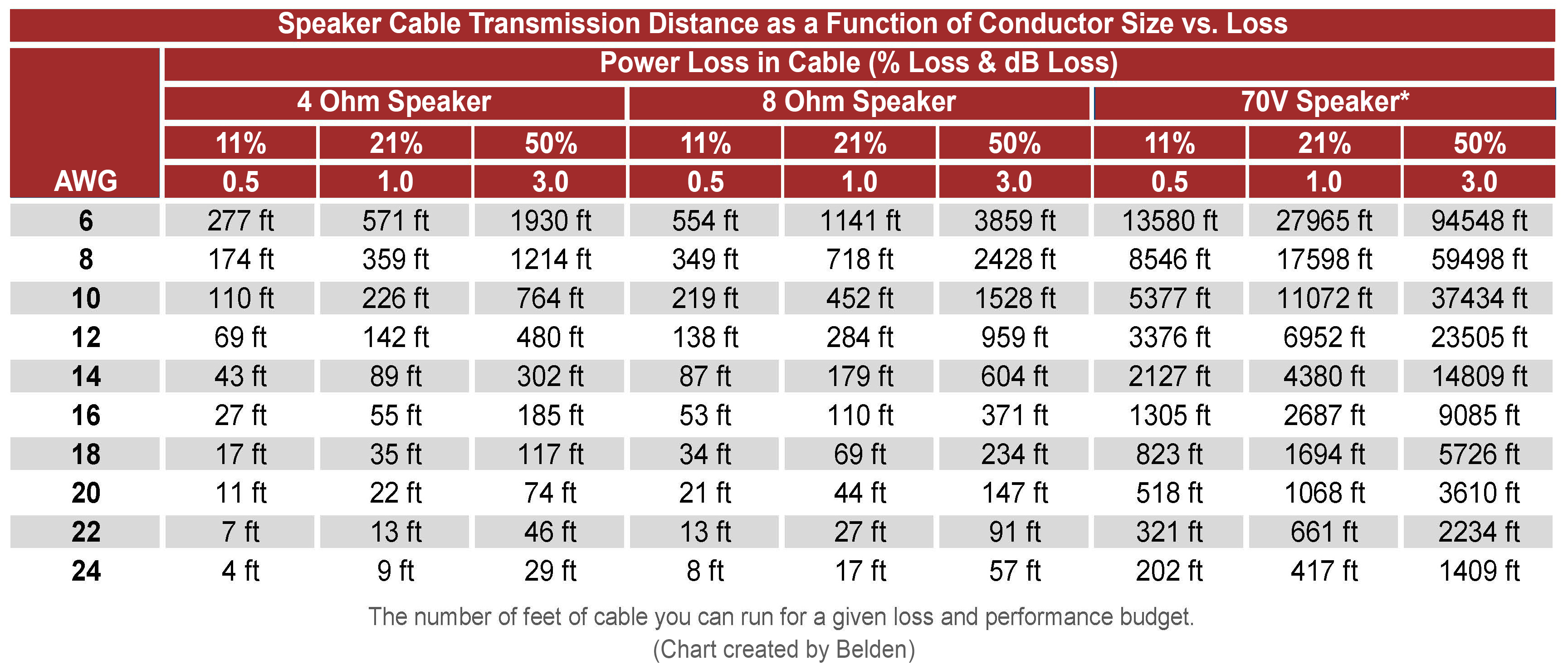
Image Credit: Belden
How to Minimize Power Loss
To get the most out of your sound system, especially over long distances, consider these strategies:
-
Use Thicker Wire: Choose lower-gauge cables to reduce resistance.
-
Keep Cable Runs Short: The shorter the cable, the less power you lose.
-
Choose Quality Materials: Use high-conductivity wire, such as oxygen-free copper, to reduce resistance and improve durability.
-
Consider a 70V System: In commercial applications, 70-volt distributed audio systems operate at higher voltages with lower current, which minimizes the impact of cable resistance. This makes them far more efficient for long cable runs compared to low-impedance systems, reducing both power and signal loss over distance.
To illustrate, here's a real-world example:
Running 500 feet of 18-gauge wire to an 8-ohm speaker can cause nearly 6 decibels of volume loss, meaning more than half of the amplifier's output power is lost before reaching the speaker. Using 12-gauge wire over the same distance reduces the volume loss to about 3 decibels. Alternatively, using a 70-volt sound system allows cable runs up to 6,000 feet before experiencing a 3-decibel loss, a significant improvement simply by changing the system design.
Key Takeaways
-
Thicker wire lowers resistance and delivers more power to the speaker.
-
Shorter cable runs reduce wattage loss.
-
High-quality wire improves signal strength and reduces resistance.
-
70-volt systems are ideal for long cable runs and large installations.
Learn More
Understanding the impact of speaker power loss over distance is key to optimizing your sound system's performance. By selecting the right wire gauge, keeping cable runs short, and considering system options such as 70-volt setups, you can ensure your speakers receive the power they need for clear, strong sound.
If you have questions or need further guidance, don't hesitate to reach out to one of our sales engineers. They're happy to help in any way they can!