
If you've ever struggled with muddy audio, low-frequency rumble, or distorted bass, you're not alone. One simple and powerful tool that can clean up your sound is the high-pass filter, also known as a low-cut filter. In this guide, you'll learn what a high-pass filter is, how it works, and how to use it effectively, featuring the Yamaha MG06X mixing console as a practical example.
What Is a High-Pass Filter and What Does It Do?
The primary purpose of a high-pass filter is to remove low-frequency content that does not enhance the clarity or quality of a mix.
This includes:
Handling noise from microphones
Wind rumble in outdoor environments
Electrical hum or interference
Excessive bass buildup that can overwhelm smaller speakers
In simple terms, a high-pass filter allows only higher frequencies above a certain cutoff point to pass through while reducing or eliminating lower frequencies. On the Yamaha MG06X, this feature is activated with a simple button press. The cutoff point for its high-pass filter is typically around 80Hz, meaning frequencies below this point are reduced while everything above remains unaffected. It effectively removes unwanted low-end noise from microphones and other audio sources, resulting in a cleaner, more focused mix. Additionally, it helps prevent distortion in smaller speaker systems that cannot accurately reproduce deep bass frequencies.
High-Pass Filters In Action
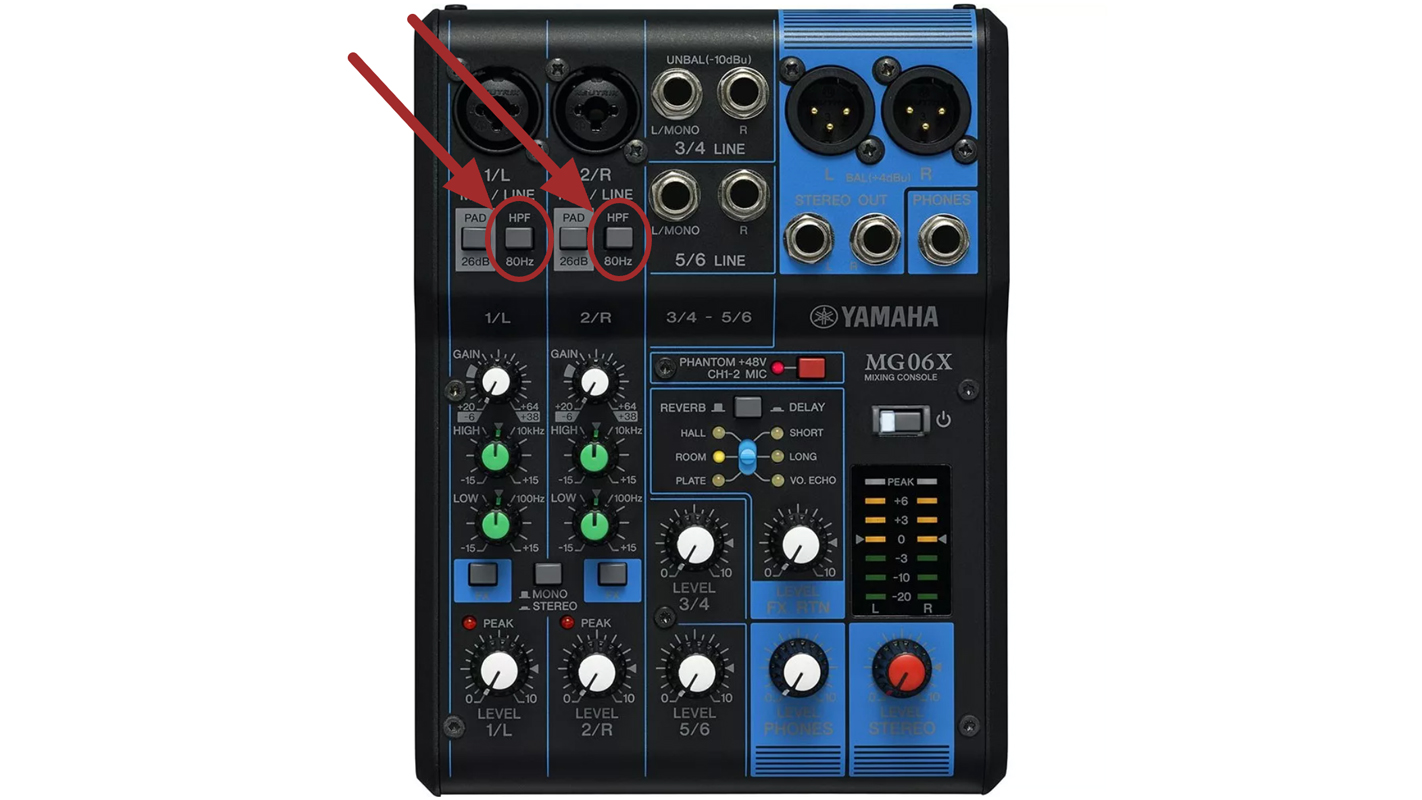
The impact of a high-pass filter is immediately clear when applied to a vocal microphone. Without it, the voice can sound boomy or muffled due to excessive low frequencies. Once engaged, the filter removes this unwanted low-end clutter, resulting in a clearer, more defined sound that gives the voice greater presence. It also helps minimize noise from accidental bumps or handling, keeping distractions out of your recording or live sound.
We’ve all been in a live setting where the presenter’s voice is hard to understand because it’s too low and muddy. In these cases, engaging a low-cut filter helps tighten up the bass frequencies, making the speech clearer and more intelligible. This same principle applies to music, where the filter cleans up bass-heavy tracks, allowing each instrument to come through more distinctly and balanced.
Differences Between Low-Cut and High-Pass Filters
The terms low-cut filter and high-pass filter are often used interchangeably because they describe the same process: allowing higher frequencies to pass through while reducing or cutting lower frequencies.
However, these should not be confused with low-pass filters, also called high-cut filters, which work in the opposite way. A low-pass filter lets low frequencies pass through while cutting off higher ones. For example, low-pass filters are commonly used to shape the bass output of a subwoofer. Simply put, a high-cut is the same as a low-pass, and a low-cut is the same as a high-pass.
Reflection
The high-pass filter is one of the easiest and most effective tools for improving audio clarity. Whether you're recording vocals, mixing music, or managing sound in a live setting, knowing how and when to use this filter can make a significant difference.
If you have any additional questions about high-pass and low-cut filters, our dedicated Sales Engineers are happy to help! Feel free to call (866) 676-7804 or email [email protected].
For a simple and effective way to apply these filters, check out the Yamaha MG06X 6-Channel Mixing Console for cleaner, clearer audio. Shop today!