
2.4 GHz Digital Wireless Microphone System Comparison on Pro Acoustics Tech Talk Episode 11
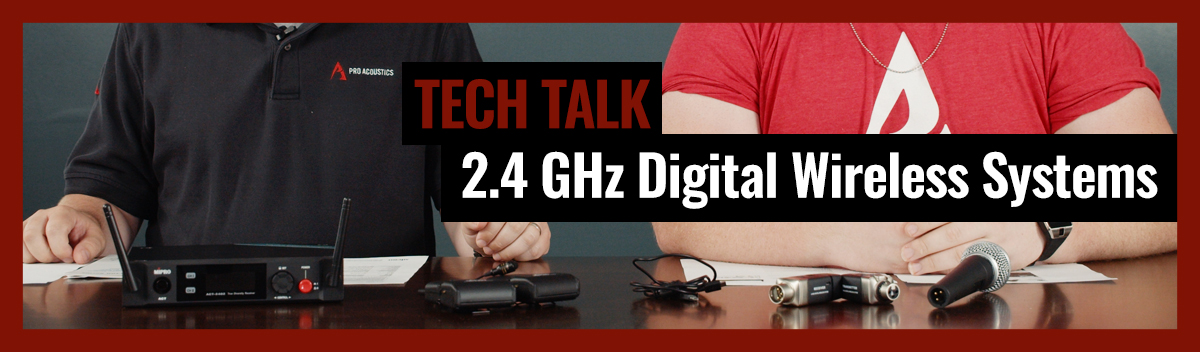
On this week’s episode of Pro Acoustics Tech Talk, Nathan and Coltin are explaining 2.4 GHz digital wireless technology and comparing 2 digital wireless microphone systems from Xvive and MIPRO.
Hey everybody, thanks for joining us for another edition of Pro Acoustics Tech Talk. I'm Nathan, I'm Coltin, and we are here today to talk to you all about 2.4 GHz digital wireless microphones. Digital wireless mics - what are they, how do they work? And then introduce you to a couple of our favorites here.
All right Nathan. So, we have some digital wireless mic solutions in front of us. So, I see we have some nifty new products on the market or product I would say on the market. And then we have something really cool from MIPRO as well. So, kind of explain to me this digital, you know, digital conversation of a wireless system. Kind of break it down for me.
Yeah, sure. So, in the wireless microphone world right now, you're going to have analog wireless and then also digital wireless. So I don't by any means have a doctorate in a RF wireless technology. So, we're going to keep things very base level here. So, if you happen to have one of those doctorates, keep it to yourself for a little bit. All right. So basically, as we all know, the wireless microphone spectrum in America has gotten a lot more compact recently. Yeah. The FCC did away with the 700-megahertz band - auctioned that off a few years ago to major telecom companies and that kind of thing. And now the same thing is happening again in the 600 megahertz band. Gotcha. Also, the big TV stations are broadcasting wireless HD television stations all over the country, all over the bands, which makes your average touring audio guy's life a little bit tough sometimes. A few headaches.
Yeah, exactly. So a lot of people are looking for how to escape, how to get away from it. How can you find working wireless microphone channels in 2019? So, what some of the manufacturers have done, is actually taken to the digital space operating in 2.4 GHz or, or thereabouts. Some of you may know a little thing or two about 2.4 GHz. That's the frequency spectrum where your wireless routers operate, your waps, which is it guy code for wireless access point, like you see up in the ceiling in hospitals and things like that. That space is allowed to operate a little bit differently. And right now, there's not a lot of other folks in that spectrum other than WIFI and then now microphones over the course of the last couple of years. So, there's a lot of give and take and a lot of pros and cons of going one way or the other as far as digital.
Once again, we can always help with that conversation. When you guys do have questions about what kind of microphone you need. Some of those pros and cons, just to kind of give you a high-level flyover, and you'll find debates about these all over the internet as far as which one's better, which one will always work better? 2.4 GHz digital technology can actually sound better, because of just kind of how the electronics of it all work - the actual electrical signal. But it also becomes a little bit more challenging to do lots of frequencies. So, the tour, because of the amount of bandwidth in the 2.4 GHz space, it's hard to do lots and lots of wireless microphones at one time, on the 2.4 GHz or the 1.9 GHz band or thereabouts. Whereas with conventional analog RF, you know, in the 500-megahertz band, 400 megahertz band, you can put more frequencies in there in those spaces.
Gotcha. So, 2.4 GHz, you're not going to see as often in like the touring guy kind of level. But for the local church, the local teacher, a local boy scout troop, you know, that kind of space can be a very easy solution to get away from some of the RF headache. From there we've got different options of which ones to use. Now, 2.4 GHz mics are made by companies - Shure, Sennheiser, Audio-Technica. MIPRO, like we have here. All the usual microphone manufacturers make digital microphone systems. They're available with body packs, with lapels, with headsets, with handhelds, just like all the other microphone systems are. But they can be useful, like I said, for avoiding some of the RF issues. To kind of give you guys an idea. If you're in Dallas, Chicago, New York City, La, you can find yourself in situations where you have a lot of wireless activity going on all around you and you don't even know it, which can make it tough for finding a mic to work for your school or for your personal event.
2.4 GHz can sometimes help get you out of that. But if you've got tons of routers and things like that in the digital space as well, sometimes you’re not quite out of the woods. But digital is a great option to pursue for cost-effective wireless and also some better sounding stuff on the higher end of the price spectrum. Absolutely. Absolutely. So more specifically, you know, we have a great new product on the market called the Xvive here. It's really, really, I haven't seen anything like it as far as the ease of use and just the interface of the actual front panel here. Just go over why something like this even exists with me a little bit. Because, like I said, they really, really went out of their way to, you know, craft such a, you know, place in the market where something like this was needed.
So, yeah, so you got it. The Xvive is kind of a newer product like you mentioned and it's very cool. And then it has rechargeable, battery rechargeable wireless transmitter, and wireless receiver. So, what that means is, you know, your transmitter can plug into any of your own microphone transmitter. Here I have our Pure Resonance Audio UC1S that I've talked to you about before in the past - has its own on and off switch and now you have essentially a wireless microphone system. It's got its own power, its own mute switch and it also has a number of different wireless channel options on the bottom. This is fully rechargeable from a wall outlet, and then it communicates back to its transmitter, which is also completely portable, rechargeable. And this basically is just an XLR input that can plug directly into your mixer, into your channel or into a microphone cable into a channel, and then also has its own power button, its own individual channels, to where you can easily turn it on and off. So, in essence, instead of having to have a piece of rack gear like this, we can actually plug this into the back of a powered speaker like the Bose S1 we've talked about before. Any other wireless or pardon me, any other speaker option that has a microphone input, we can then plug this wireless transmitter into and then essentially instantly have 2.4 GHz wireless microphones. So also, with digital, one thing we didn't cover, digital does have a little bit shorter range than um, analog RF. Analog RF normally can broadcast up to about 200 feet or so. Okay. That's also in perfect scenarios, with good line of sight and that kind of thing. Digital is normally a little bit shorter, normally closer around 100 feet. So keep that in mind when we're looking at these types of options.
But beyond the Xvive, we can also look at MIPRO, who also makes a great quality, built tough, digital microphone system. MIPRO is going to have dual channel receivers like we have here, which are, this is our ACT 2402. It's a dual-channel receiver, two different outputs. You've got two XLR outputs on the back so that you can, come out to two different individual channels and make adjustments as needed. And then from there, you can have two different combinations of transmitters. The one we have here has a lapel microphone. The other has a lapel mic also, but it could very well have a headset, an earset mic, you know for a church pastor. It also could be adapted on this plug to plug in a quarter inch input for like an acoustic guitar or any other instrument with a pickup in it.
Or once again we could have had a handheld mic or any combination. What's cool about the MIPRO ACT stuff is that your transmitter is a la carte, so you can actually pick which one you want to go along with the package, pick your flavors. Yeah, yeah. Awesome. So, like we see here, we can do with digital RF basically the same things that we can do with analog RF, but, it has its own benefits and its own drawbacks, which make it a viable option in the marketplace with some really cool, very simple options being introduced.
Absolutely. Absolutely. And again, if you have any questions or you know, any hesitation on, you know, what's best for you, that's why we're here. I mean, definitely, definitely reach out to either one of us. You can reach me directly at Coltin at coltin@proacoustics.com or can they reach you at nathan@proacoustics.com. Give us a call at our 800 number – (888) 256-4112. Drop us a line below. Go to the website www.proacousticsusa.com. Let us know how we can help. Absolutely. Until next time. I'm Coltin. I’m Nathan.