
Why You Shouldn’t Choose Home Audio Products for Your Commercial Space on Pro Acoustics Tech Talk Episode 19
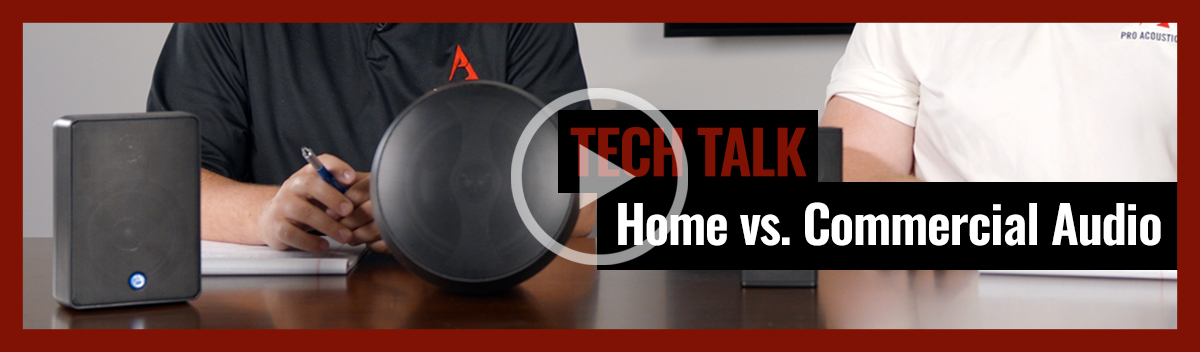
On this week’s episode of Pro Acoustics Tech Talk, Nathan and Coltin are discussing some of the differences between home and commercial audio and a few reasons why you shouldn't be putting home audio gear into commercial spaces.
Hey everybody. Thanks for joining us again for another edition of Pro Acoustics Tech Talk. We are filming from our Salado, Texas location. I'm Nathan. I’m Coltin. And we are back again to talk a little bit more about audio. Of course. Today we are talking about some of the differences between home and commercial audio. It comes up a lot, people wanting to use home audio products in commercial environments. So, we want to talk a little bit about why that's not always a great idea and what commercial audio can do for you.
Okay.
All right, Nathan. So, home versus commercial. Probably, you know, one of the most talked-about topics I have with a lot of customers is, you know, I have this system laying in my house, I was thinking about implementing it into my new restaurant or retail store or you know, anything like that. And we always say, hey, stop right there and you know, this is why you shouldn't do that. And, we just want to relay that message on to you. So, give me a little bit of a scoop of why you shouldn't be putting, you know, like say home gear into commercial spaces, and what's the major risks and then downfalls of doing so.
Gotcha. So, there's a lot of different reasons and a lot of things that come into play while we're talking about this topic. Yeah. So, I might not hit on all of them here, but I want to make sure and give you guys some of the highlights. One of the major things to think about when you're looking at using a home system in a commercial environment is the amount of use of the product. So generally home audio products are kind of designed for you get home from work, turn on the game. Yeah. Turn on the big game, sit down, watch the game, watch the movie, you know, do that kind of thing, turn it off and then it's done. Two or three hours, few hours, it gets powered off, that kind of thing. A commercial environment, if you guys have restaurants or hotels or, you know, retail stores, you start to think about the number of hours you're open.
You know, it can be 10, 12, 14 hour days. You know, if you think about some of these 24-hour restaurants are open all the time, all the time. So that means the audio systems on all the time. So as a result, one thing you got to keep in mind here is that commercial audio products are built to be a little tougher, a little bit more robust power supplies. Electronic devices actually have voltages and wattage running through them all the time. So absolutely, there's a little bit more care and a little bit more professional-grade hardware built into commercial audio systems. For sure. So, you want to kind of keep that in mind. As a result, along those lines, one big thing we got to mention is longevity. Yeah. You're going to have longer warranties in a lot of your commercial product.
I mean, sometimes you've got one-year, five-year, three-year, 10-year type warranties on some of the electronics in commercial audio systems. We field phone calls all the time from guys with, you know, warehouses or factories with, you know, Bogan or TOA mixer amps. They've been running for years, 25 plus years. You know that you can't always expect that, but, that's gonna be a commercial-grade product built tough. Buy it once and it lasts for a very long time. Exactly. The other thing to kind of take into consideration there though is also to a degree, the matter of safety. Mixer amps in a commercial environment are going to be built to be grounded electrically correctly. They're always going to be grounded for the most part. They're also going to be built in such a way to help dissipate heat appropriately knowing that these electronics are going to be on, going to be running, you know, fan-cooled mixer amps, things like that versus a lot of home products.
You know, they're expecting they're just going to be on for a few hours. Exactly. That's big. You know, it can be a safety concern of if your mixer amp, sorry, your home receiver is going to be running hot and is hot to the touch. You don't want that in a commercial environment day after day while you're carrying on having business. Yeah.
There's also a little bit different actual audio signal between home and commercial audio. If you've got a home receiver powering your system, say it's 5.1 or something like that, five speakers off of it, five, you know, that's really all you can do because of impedance and things like that. We'll do another spiel all about speaker impedance one of these days for you guys, but you pretty much max out on a speaker or two per output depending on the impedance.
So if you come to me and say, Nathan, I want to power an additional amplifier. Many times, the outputs are going to be, you know, more of a commercial or a consumer-grade output, you know, which is going to be weaker signal than what a commercial grade amplifier wants to see most of the time. So, you can't really mix and match home and commercial very well, because of the actual audio signal itself. Yep. On the lines of talking about signal, the output from home audio receivers is almost always going to be eight ohms or four ohms or six ohms, whatever they call it. So, everything that you guys learned about 70 volt that we talked about before, why it's kinda beneficial running cabling long distances, before we get any wattage loss, making sure you don't have to worry about that dampening factor as much, you know, also making sure that every speaker gets the same level of signal. All that goes out the window when you start dealing with a home audio receiver because you can potentially be using too small a cable that can't run longer distances. So you get wattage losses to long runs to speakers in the back of the building. So it might be louder in the front where you have your receiver and quieter in the back, you know, and once that, yeah, you can get into a lot of problems, by just using just normal out of the box home type receivers and these kinds of situations instead of commercially built products built tough built to last, built with safety and longevity in mind that you can count on to work for you for years and years.
We just have some, you know, samples here of some of like the different products out there. This is our Pure Resonance Audio Mini Cube. And make no mistake, I'm not anti-home audio. I have, yeah, I like hooking up speakers in my house, but in commercial places that's, they don't belong in commercial places. That's where you need to look more at commercial-grade speakers. Whether you want to do 70-volt or low impedance, that's still a different conversation. You can do commercial grade low impedance, you know, with the right kind of mixer amplifiers, the right kind of electronics. But with 70-volt, you can also trust that you're going to get more efficiency, more like my dad used to say more horsepower to the rear axle, and there you're going to get more efficiency. You're going to get more wattage actually making it to the speaker, which is going to be built to last longer, to work day after day to where you don't have to walk in one morning and figure out why do I not have an audio system?
Yep. Commercial grade audio gear is something you should be able to count on and count on day after day. Absolutely. If you have questions though about what kind of audio system you want to do, it's why we're here, what kind of products you need help with. Reach out to us. We've got 70-volt commercial-grade systems for any kind of application on our Amazon store. Also, on our Pro Acoustics website. You can go there at www.proacousticsusa.com or reach out to us on our 800 number – (888) 256-4112. Reach out to me directly. It's nathan@proacoustics.com, and I'm coltin@proacoustics.com. It's Coltin with an i. And just let us know what we can do to help out. And, if you do like what you see here, if we help teach you guys a few things, let us know.
If I did happen to miss anything here, you're always welcome to let me know on that. We had some good catches from some other viewers previously on a few things that I overlooked. Sorry. That's great. I'm not perfect. Once again, I'm not an electrician either, so don’t blast me on some of those kinds of topics. But we'd love to share our knowledge with you guys and see what we can do to get you what you need for whatever your audio application is. Click the button, give us a like, subscribe, tell your friends and onto the next one. Yeah. Until next time. I'm Coltin. I'm Nathan. See you next time.