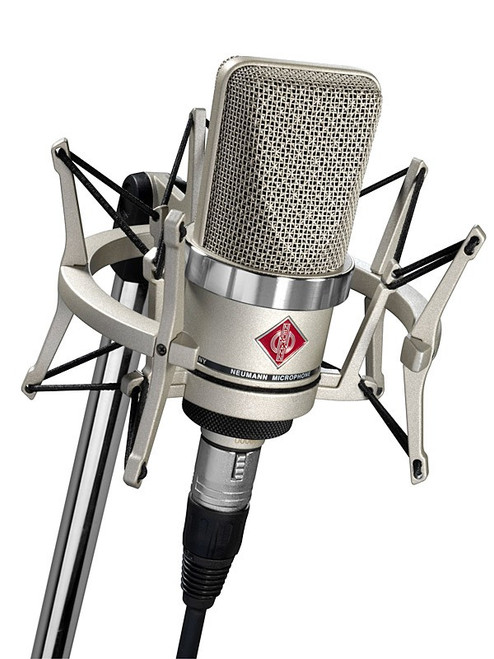
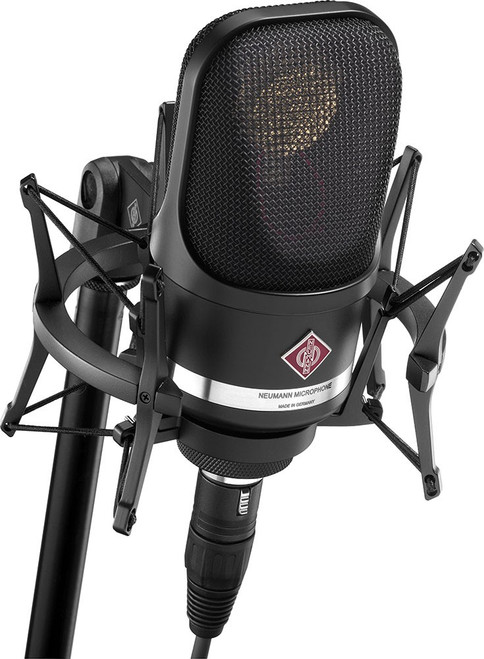
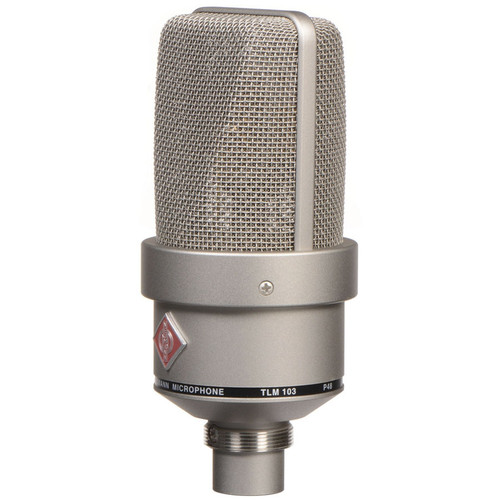
Five directional characteristics are selectable by means of a rotary switch. In the sixth position, marked "R", the directional patterns can be controlled remotely with the N 248 power supply. There is no special cable necessary for this purpose.
The microphone has at its rear a 10 dB attenuation switch for extremely high sound pressure levels, and a high-pass filter to suppress structure born noise.
The TLM 170 R condenser microphone is a large diaphragm microphone with multiple polar patterns. Its sound has a very transparent characteristic, in contrast to some of our other microphones that have a distinct personality.
Therefore, this microphone is used for many diverse applications in professional recording studios, in broadcasting, film and television, and for semiprofessional productions. The polar patterns can be selected either at the microphone itself, or controlled remotely through the special N 248 power supply.
The microphone is addressed from the front, marked with the Neumann logo. The large diaphragm capsule inside the headgrille has a very smooth frequency response for all polar patterns over a wide acceptance angle. The curves are flat and parallel to the 0° frequency curve up to 10 kHz within an angle of ± 100°.
As a result the TLM 170 R has a very even diffuse-field response for all polar patterns. This is important in a reverberant environment, as more reflections arrive at the microphone from different directions. The acoustic information is not affected in its tonal quality when recorded by the microphone. This characteristic is achieved without resorting to corrective resonance effects.
Therefore, the microphone maintains an excellent impulse response reproducing all transient phenomena of music and speech without any coloration. The capsule is elastically mounted to avoid any structure borne noise that could interfere with its operation.